✏️ Straight-Line Letters: The Smart (and Musical!) Way to Teach Capitals
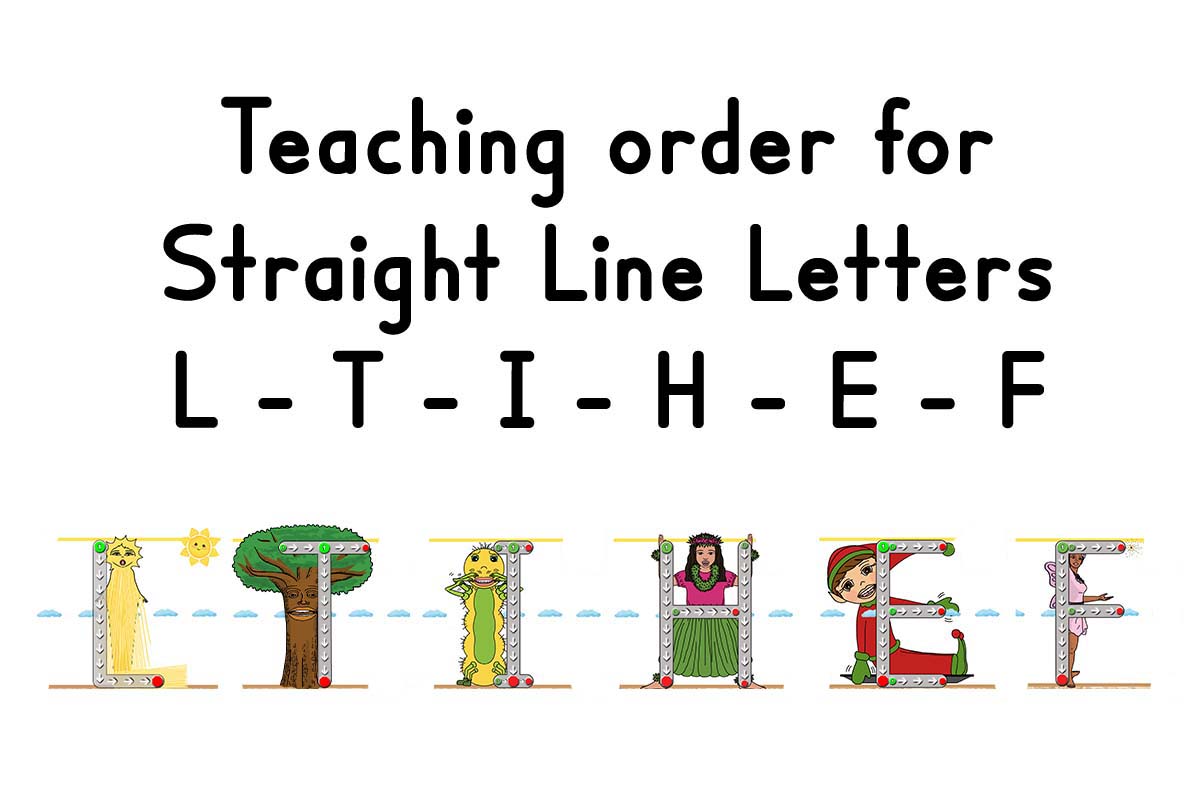
L → T → I → H → E → F
When little writers begin learning handwriting, not all straight letters are created equal!
Some are simple two-stroke confidence builders, while others require precise spacing, rhythm, and even a bit of self-control.
Understanding why certain letters come first—and adding music to the mix—helps teachers bring handwriting to life while keeping learning joyful. 🌈
✅ Suggested Teaching Order
Easiest → Hardest:
L → T → I → H → E → F
🧩 Why This Order Works
| ✨ Letter | ✍️ Motor Complexity | 🧠 Skill Level | 💡 Why It Matters |
|---|---|---|---|
| L | 2 strokes (vertical + bottom line) | Low | Simplest start—both strokes on the baseline. |
| T | 2 strokes (vertical + top line) | Low–Moderate | Same movement as L, but the crossbar “floats,” teaching control above the baseline. |
| I | 3 strokes (top, vertical, bottom) | Moderate | Adds top and bottom spacing—introduces proportion. |
| H | 3 strokes (vertical + vertical + bridge) | Moderate–High | Requires equal spacing between two lines and a centered bridge. |
| E | 4 strokes (vertical + 3 horizontals) | High | Adds rhythm—top, middle, bottom—building letter sequencing. |
| F | 3–4 strokes (vertical + 2 horizontals) | Highest | Looks like E but without the bottom bar! Children must inhibit a learned pattern—a higher cognitive skill. |
🧠 What the Research Says
📏 Motor Simplicity Comes First
Children master straight lines (vertical + horizontal) before adding curves or diagonals (Griffin OT).
👀 Visual–Motor Integration Builds Gradually
The Beery–Buktenica VMI framework shows spacing, symmetry, and midline awareness grow between ages 4–6.
🧩 Cognitive Flexibility Follows
Overvelde & Hulstijn (2009) and Van Gal-Brauner et al. (2010) found that once motor patterns are stable, children can handle “rule changes” (like remembering F = E minus one bar).
🛑 Inhibitory Control Develops Last
Suppressing a learned action (“don’t add the bottom bar to F!”) is neurologically more advanced than simply repeating a pattern—so F belongs at the end of the sequence.
🎶 The Magic of Music in Handwriting
Music isn’t just fun—it’s science! 🎵
When kids sing or move to rhythmic handwriting songs, multiple parts of the brain light up—auditory, visual, and motor areas all working together.
-
🎧 Rhythm = Memory. The beat helps children remember the correct stroke order.
-
🧠 Multisensory learning. Combining music + motion + visuals strengthens neural connections.
-
✋ Motor timing. Rhythmic cues improve smoothness, directionality, and line control.
-
💕 Engagement & confidence. Music transforms repetition into play and keeps focus high.
Research in occupational therapy and child development shows that rhythm-based movement improves motor planning, sequencing, and self-regulation—skills at the heart of fluent handwriting.
🌟 Using La La’s Letters Handwriting Songs in Your Classroom
🎤 Whole-Class Mini Lessons
Start handwriting time with a song!
-
Project your La La’s Letters Straight-Line Songs playlist. https://youtube.com/playlist?list=PL50c7qalC2sVVmvS0ESM9SrVwxNfwFyzZ&si=hMN9G8A_oqaALJau

-
Model the letter on the board while singing the stroke cues (“Down… across!”) along with the video. Encourage children to join and sing while they write.
-
Have students sky-write or trace on their desks in rhythm.
It’s the perfect brain warm-up before handwriting practice!
🎧 Small-Group Centers
-
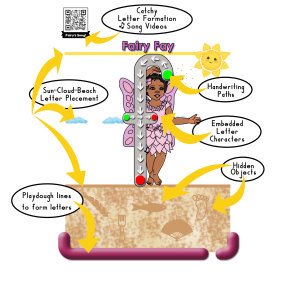
Set up a Handwriting Song Center with laminated wipe-and-write pages and a tablet or QR code linked to your Straight Letters playlist.
-
Children work in pairs, tracing while the music guides each stroke.
-
Add instruments or clapping patterns for extra fun—and extra brain connections!
💬 Teacher Tip
Repetition through song builds automaticity faster than silent tracing alone.
When children sing, move, and write together, they learn through sound, sight, and motion—the most powerful trio for long-term mastery.
💡 How to Apply This in La La’s Letters Centers
1️⃣ Starter Set – Confidence Builders
L + T
Introduce these first to build success fast.
Model straight-line strokes from the sun line to beach line, and celebrate every clear top-to-bottom movement.
Characters: 👩 Lady Light (L) and 🌳Talking Tree (T)
2️⃣ Next Step – Alignment & Spacing
I + H
Now children learn about equal spacing and connecting bars.
Use verbal cues like “Top – Down – Bottom” for I, and “Two poles and a bridge” for H.
🐞and 🧚♀️ Characters: 🐞Itchy Insect (I) and 💃🏽Hula Hana (H)
3️⃣ Challenge Set – Pattern & Rule Change
E + F
Teach the top–middle–bottom rhythm with E first.
Then introduce F as the “short E without shoes.”
🧝♂️ and 🧚♀️ Characters: Eddy Elf (E) and Fairy Fay (F)
Story cue:
“Eddy Elf builds three ladders—top, middle, bottom.
Fairy Fay runs out of wood—no bottom step!”
This tiny narrative helps children remember the rule and apply self-control with a smile.
🪄 Teaching Tips
-
🎨 Model vertical first, then add horizontals.
-
🎵 Play a handwriting song while modeling each stroke.
-
🖍️ Guide tracing before independent writing.
-
💬 Praise accuracy and effort—not speed!
-
🎧 Use rhythm and music to reset focus between letters.
📚 Why It Matters
Teaching in a science-backed sequence reduces frustration, boosts memory, and keeps learning joyful.
Music adds emotion and rhythm—the secret ingredients that turn practice into play.
✨ Takeaway Chart
| Level | Letters | Focus | Example Cue |
|---|---|---|---|
| Starter | L, T | Straight lines | “Down and across.” |
| Builder | I, H | Alignment | “Top–Down–Bottom.” / “Two poles and a bridge.” |
| Challenge | E, F | Rhythm & Rule Change | “Three bars for E, two for F.” |
🌈 Final Thought
When you teach straight-line capitals in the sequence L → T → I → H → E → F—and add joyful music—you’re not just teaching handwriting.
You’re growing confident writers, strengthening little brains, and creating classrooms filled with rhythm, movement, and smiles. 💛🎶