The Scenario: You ask your student to write “bed,” and they proudly produce “deb.” Sound familiar?
The ‘b’ and ‘d’ letter reversal is one of the most common—and persistent—hiccups in early literacy. It’s frustrating for kids, and confusing for parents and teachers.
But don’t worry, the struggle isn’t a sign of poor learning; it’s a natural result of how the young brain processes visual information! The good news? We have a fun, research-backed secret weapon: the continuous stroke combined with two unforgettable mnemonic songs!
The Science Behind the Switch: Why Our Brains Get Confused
Why do these two letters cause so much trouble? Our brains are built for efficiency, and one of the ways they save energy is through visual generalization. If two objects look almost identical—like a chair and a chair flipped 180 degrees—the brain recognizes both as “chair.”
‘b’ and ‘d’ are rotational twins! It takes conscious effort and strong motor memory to teach the brain that orientation matters here. The key to solving the flip isn’t just looking at the letters; it’s about how they are formed.
The Research-Backed Secret: Continuous Stroke
The latest research in handwriting development points to the continuous stroke method as a powerful tool to prevent this visual confusion.
The traditional “ball-and-stick” method requires multiple steps: draw the stick, lift the pencil, and draw the circle. This lift-and-move action is where the brain often loses its place, forgetting which direction came first.
The continuous stroke approach solves this by forcing the creation of two entirely different motor pathways for ‘b’ and ‘d’, which we can easily teach with our mnemonic songs:
🏏 1. Batty and Ball (The ‘b’ breakthrough)
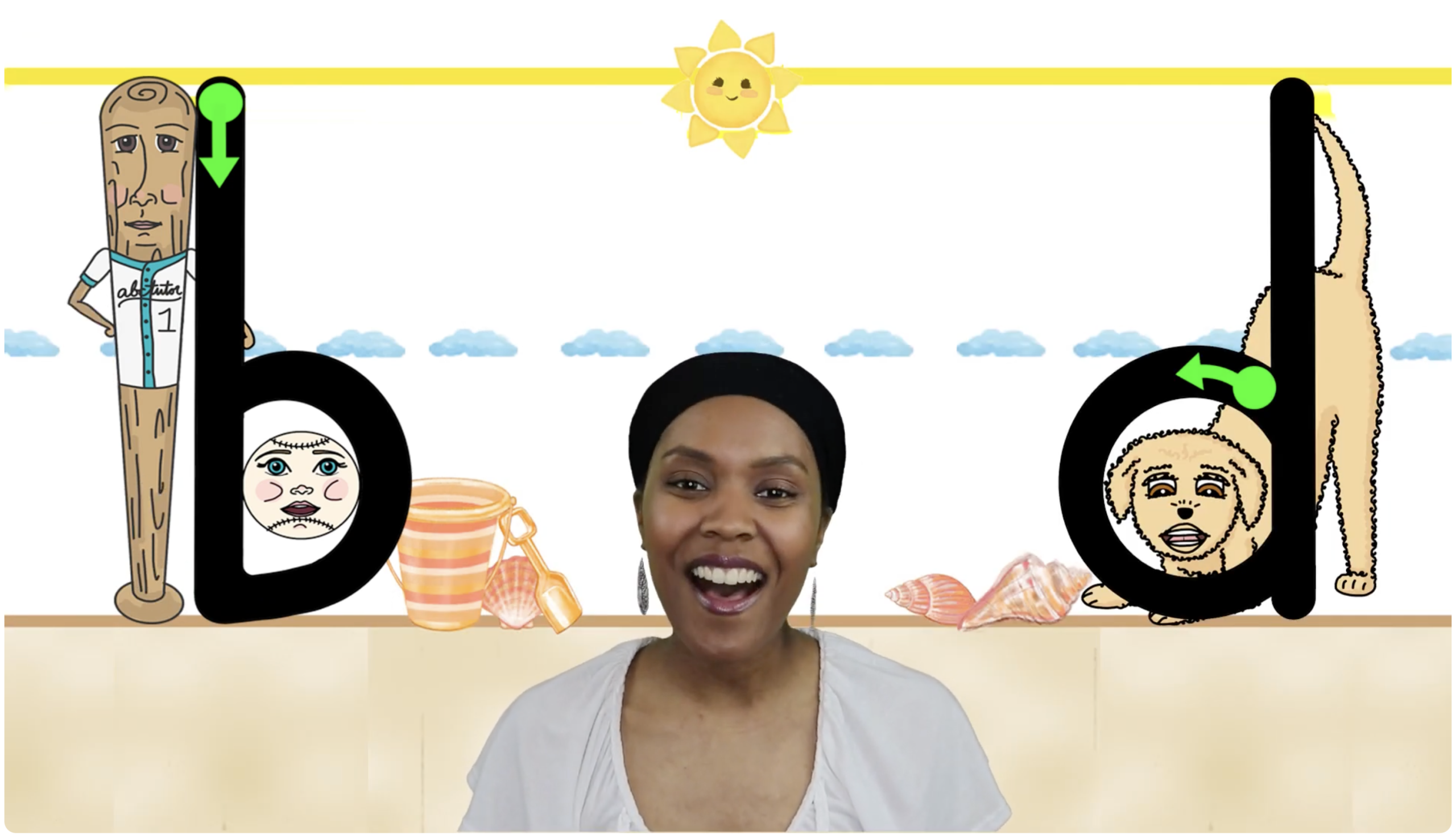
This mnemonic uses the image of a baseball bat and a baseball as the embedded character for the lowercase ‘b’. This is brilliant because it perfectly aligns the formation with the continuous stroke rule:
- The Song’s Formation: The catchy words guide the hand: “First draw down the bat, bounce, then all around the ball.”
- The Continuous Stroke Principle: The vertical line (bat) is drawn before the curve (ball), establishing a distinct stick-first motor pattern. This crucial sequence is physically the opposite of how you start a ‘d’, which locks the correct shape into the child’s motor memory.
🐶 2. Doodle Dog (The ‘d’ direction)
For the letter ‘d’, this mnemonic provides a clear, circular starting point, again ensuring a distinct motor path:
- The Song’s Formation: The song teaches the child to pat around the dog’s head first, then up to his tall tail, and down again.
- The Continuous Stroke Principle: This translates directly to a curve-first motion (starting the letter like a ‘c’), which is the opposite of the ‘b’ formation. This immediate, clear difference between starting a ‘d’ (curve first) and starting a ‘b’ (stick first) is the magic key to ending reversals.
Your Takeaway
Mastering ‘b’ and ‘d’ is a huge win! By combining the research-backed continuous stroke method—which emphasizes distinct starting points—with fun, memorable mnemonics like Batty and Ball and Doodle Dog, you empower your students to stop guessing and start writing with confidence and fluency. The movement becomes automatic, freeing up their brains for the important work of reading and composing!